
Cyber resilience is becoming an essential consideration for organisations navigating an increasingly complex digital environment. While cybersecurity traditionally focuses on prevention through stronger passwords, firewalls, endpoint protection and access controls, organisations must also answer a harder question:
What happens when something still goes wrong?
Cyber resilience is an organisation’s ability to prepare for cyber disruption, detect and contain threats, continue critical operations, recover effectively and learn from what happened.
It is not simply about stopping every attack. It is about making sure a cyber incident does not become a business crisis.

Cybersecurity and Cyber Resilience: What’s the Difference?
Cybersecurity focuses primarily on protecting systems, people and information from threats. Cyber resilience takes a broader view.
It assumes that even well-protected organisations can experience disruption and asks whether the organisation can continue operating when that happens.
Cybersecurity asks: How do we prevent and detect attacks?
Cyber resilience asks: If an incident happens, how prepared are we to respond, recover and continue operating?
The strongest organisations need both.
Why Cyber Resilience Matters
The cyber environment is moving faster while organisations are becoming increasingly dependent on cloud platforms, connected systems, third parties and digital services.
Artificial intelligence is changing both sides of cybersecurity. Organisations are using AI to improve productivity and security operations, while threat actors are using the same capabilities to increase the speed and scale of cyber activity.
The World Economic Forum’s Global Cybersecurity Outlook 2026 describes a fast-changing landscape in which AI is transforming cyber defence and attack, while governance, human expertise and cross-border dependencies struggle to keep pace.
This creates a simple business reality: When technology stops, business can stop with it.
For Caribbean organisations, resilience also has to account for the realities of operating in smaller, highly connected markets where businesses, government agencies and critical services may depend on a concentrated group of technology providers, telecommunications networks and regional partners. A disruption affecting one part of that ecosystem can quickly become an operational issue beyond the IT department.
What Does Cyber Resilience Look Like in Practice?
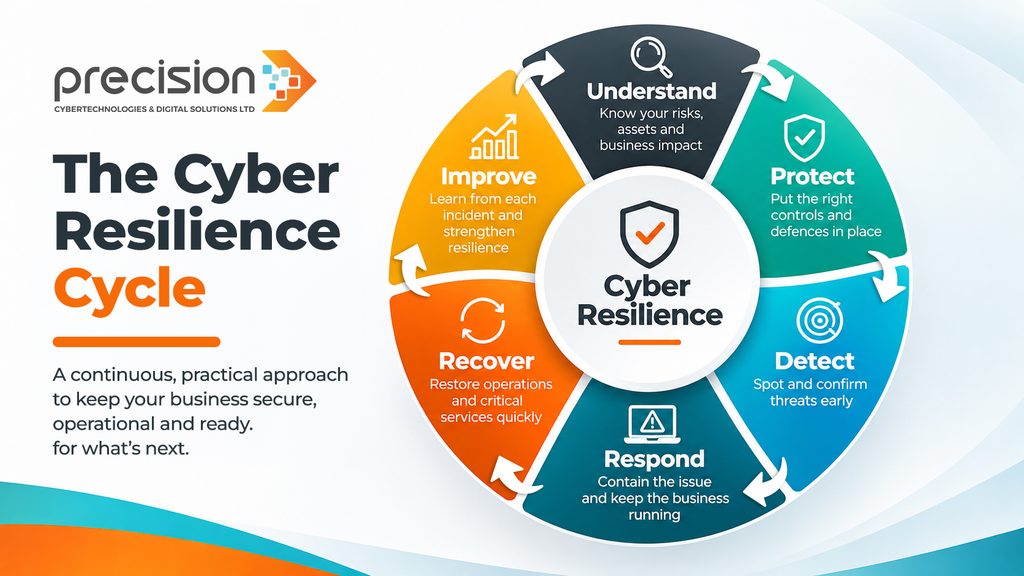
Cyber resilience is not one product, policy or department. It is the combined ability to:
Understand
Know your critical systems, sensitive information, dependencies and risks. Without this visibility, it is difficult to prioritise security investment or determine what must be restored first during an incident.
Protect
Apply appropriate security controls across identities, endpoints, networks, systems and people. Protection should reflect the organisation’s actual risk rather than become a checklist of technologies.
Detect
Identify suspicious activity early enough to act before an incident escalates. Continuous monitoring and effective detection processes help organisations distinguish normal behaviour from activity that needs investigation.
Respond
Know who makes decisions, who handles containment, when leadership is involved and how employees, customers, regulators or other stakeholders are informed.
Recover
Restore critical operations to a trusted state using tested recovery processes and clear business priorities.
Improve
Use incidents, assessments and exercises to strengthen controls, procedures, training and future decision-making.
Cyber Resilience Is a Leadership Responsibility
Cyber incidents rarely remain confined to the IT department. A significant incident can affect operations, finance, customers, communications, legal obligations and organisational reputation.
Leadership therefore has a role before an incident occurs, not only after one becomes serious. This is particularly important for Caribbean organisations operating across multiple islands or jurisdictions, where response teams, technology providers and decision-makers may not all be in the same location when an incident occurs.
If a significant cyber incident occurred tomorrow, would everyone who needs to make a decision know their role?
Plans have to be tested
A written incident-response plan can create confidence. But a plan is only one part of preparedness.
A plan tells you what should happen. An exercise tells you what actually happens.
Tabletop exercises, cyber simulations and recovery testing can expose weaknesses such as unclear decision-making authority, outdated contact information, inaccessible or untested backups, weak crisis communication procedures and overlooked third-party dependencies.
Exercises should also consider dependencies on regional telecommunications providers, cloud services, third-party vendors and partners that may be involved in maintaining or restoring critical services.

Cyber Resilience in Action: Lessons from PCDS’s 2026 Experience
This commitment to practical preparedness was central to PCDS’s inaugural Cyber Resilience: The Business Experience 2026, hosted in collaboration with the Trinidad and Tobago Chamber of Industry and Commerce from 21–23 October 2026.
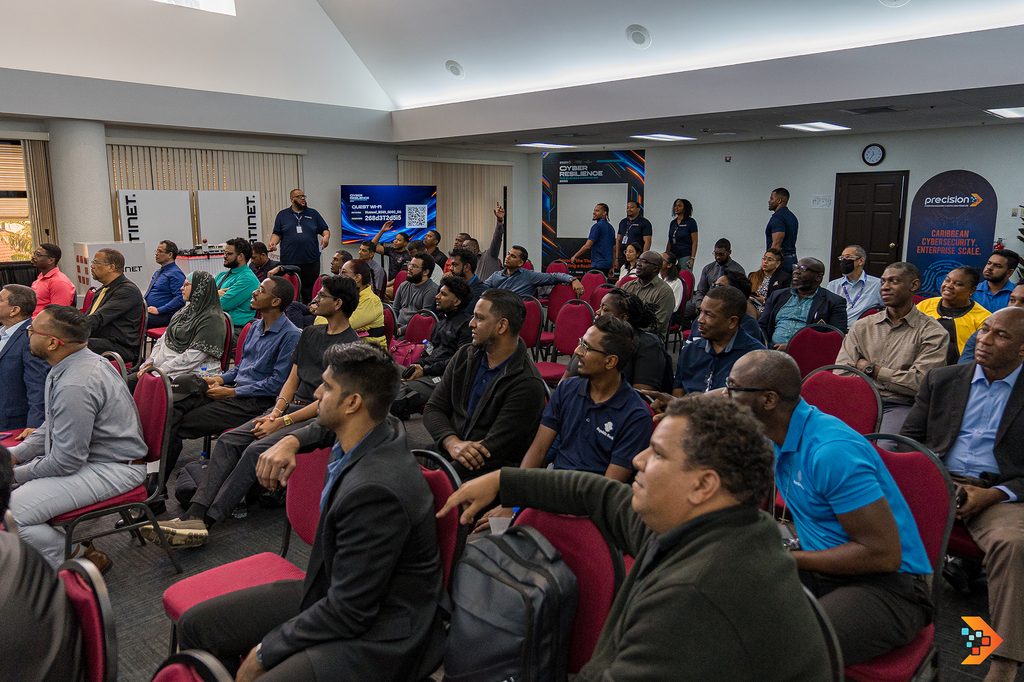
Through interactive cyber crisis simulations, technology demonstrations and expert-led discussions, participants explored how cybersecurity incidents affect business operations, decision-making and continuity. The event’s Cyber Challenge Arena also challenged participants to work through detecting, containing, eradicating and recovering from a simulated cybersecurity incident.
A recurring message throughout the three-day experience was that cyber resilience is a business responsibility, not simply an IT function.
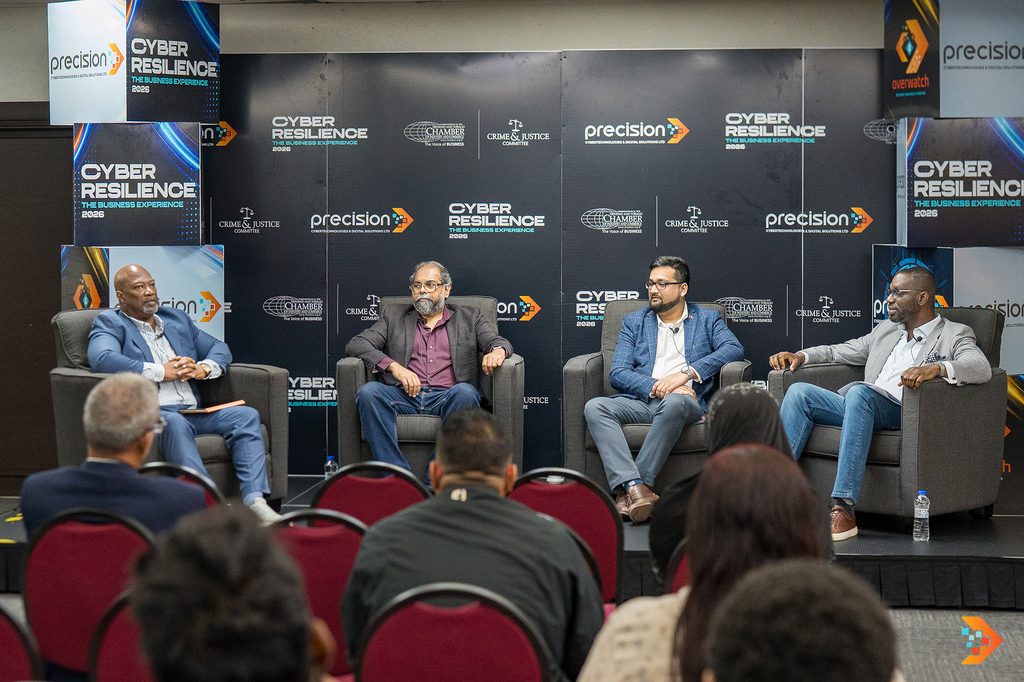
During the closing panel discussion, Shiva Bissessar of Pinaka Consulting emphasised the importance of organisations taking responsibility for their cybersecurity preparedness. David Green of CYPFER highlighted the need to move beyond preventing attacks towards developing the organisational capacity to withstand disruption and continue operating.
These perspectives reinforce a central principle of cyber resilience: organisations must prepare not only to defend themselves, but also to make decisions, coordinate their response and maintain critical operations when disruption occurs.
AI creates another resilience challenge
AI is creating significant opportunities, but it also introduces new questions. Employees may place sensitive information into AI platforms. AI systems may connect to internal data and applications. Agentic systems may be authorised to perform actions automatically.
At the same time, Microsoft’s 2026 Digital Defense Report shows AI being applied across vulnerability discovery, reconnaissance, phishing, malware and exploit development, with attack timelines compressing as automation increases.
The fundamentals remain familiar: Understand what is connected. Control access. Monitor activity. Establish accountability. Prepare for failure.
Where should organisations start?
Building cyber resilience does not mean solving everything at once. Start with the questions that matter most:
- What systems and information are critical?
- How would we know something was wrong?
- Who would lead the response?
- How quickly could critical operations be restored?
- When did we last test that process?
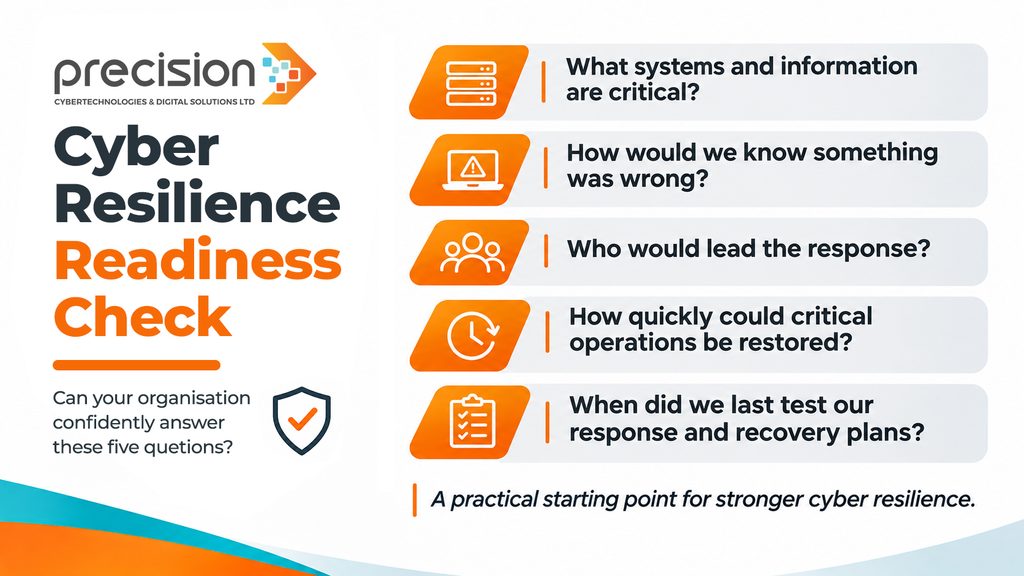
These questions can help organisations identify where further assessment, planning or testing may be needed.
How resilient would your organisation be during a real cyber incident?
Precision Cyber Technologies & Digital Solutions (PCDS) helps organisations across Trinidad & Tobago and the wider Caribbean assess cyber risk, strengthen response readiness and build resilience across people, processes and technology.