

A vulnerability assessment helps organisations identify security weaknesses, while penetration testing examines whether those weaknesses can actually be exploited.
Although these approaches are often mentioned together, they serve different purposes. Understanding the distinction helps businesses select the right security testing for their environment.
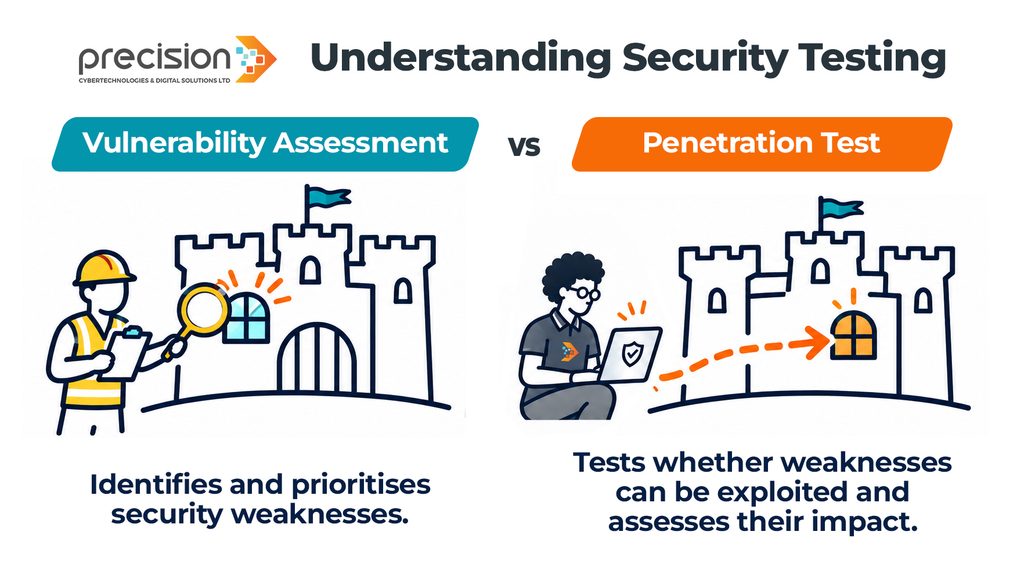
Imagine your organisation is a castle protecting something valuable.
A Vulnerability Assessment is like a safety inspector checking the doors, windows, walls and locks and identifying potential weaknesses.
A Penetration Test goes further. With permission, the tester attempts to use those weaknesses to determine whether entry is actually possible and, if successful, how far an attacker could potentially get.
A Vulnerability Assessment identifies weaknesses.
A Penetration Test tests whether those weaknesses can actually be exploited.
For organisations across the Caribbean, this distinction matters because cybersecurity budgets and internal resources are often limited. Understanding what each assessment actually provides helps businesses invest in the testing that best matches their risk and environment.
Watch: Vulnerability Assessment vs Penetration Testing
What Is a Vulnerability Assessment and How Does It Work?
A Vulnerability Assessment examines systems, networks, applications or devices to identify known security weaknesses.
- outdated software
- missing patches
- insecure configurations
- exposed services
- weak access controls
- known vulnerabilities
The objective is usually broad visibility. An organisation may have hundreds or thousands of systems, each potentially containing multiple weaknesses. An assessment helps security teams understand where exposure exists and prioritise remediation.
However, identifying a vulnerability does not automatically mean an attacker can successfully exploit it in that particular environment. That is where penetration testing provides additional insight.
What is a Penetration Test?
A Penetration Test is an authorised attempt to simulate techniques that a real attacker could use. Instead of simply identifying a potential weakness, the tester attempts to determine whether it can actually be exploited. The NIST Technical Guide to Information Security Testing and Assessment provides guidance on security testing techniques, assessment processes and analysing findings.
- whether a weakness provides access
- whether one compromised system can lead to another
- whether privileges can be increased
- whether sensitive information could be reached
- how far an attacker could move after gaining access
The objective is deeper validation of actual exposure.
When Should Your Organisation Conduct a Vulnerability Assessment?
- establishing a security baseline
- identifying vulnerabilities across multiple systems
- checking patches and configurations
- prioritising remediation
- supporting vulnerability-management programmes
- assessing environments after significant changes
- supporting compliance requirements
Organisations operating across multiple offices, islands or cloud environments may also use vulnerability assessments to build a more consistent view of exposure across distributed infrastructure.
Because environments continuously change, vulnerability assessment should generally form part of an ongoing security process rather than being treated as a one-time exercise.
When might you need a Penetration Test?
- before launching critical applications
- after major infrastructure or architecture changes
- when testing high-value or internet-facing systems
- when customers or regulators require validation
- when organisations want to test important security controls
- when existing assessments identify weaknesses requiring deeper investigation
For web applications, the OWASP Web Security Testing Guide provides a structured methodology for identifying and evaluating application security weaknesses. This can be particularly important for financial institutions, government agencies, telecommunications providers and other organisations supporting critical or regulated services across the region.
| Vulnerability Assessment | Penetration Testing | |
| Primary purpose | Identify weaknesses | Validate exploitable weaknesses |
| Coverage | Broad visibility | Targeted, in-depth investigation |
| Approach | Automated and manual assessment | Authorised simulated attacks |
| Outcome | Findings and remediation priorities | Evidence of exploitability and potential impact |
| Best suited for | Regular security assessment | Validating risks in critical systems |
Do organisations need both?
Often, yes. They provide different forms of evidence and can work together as part of the same security process.
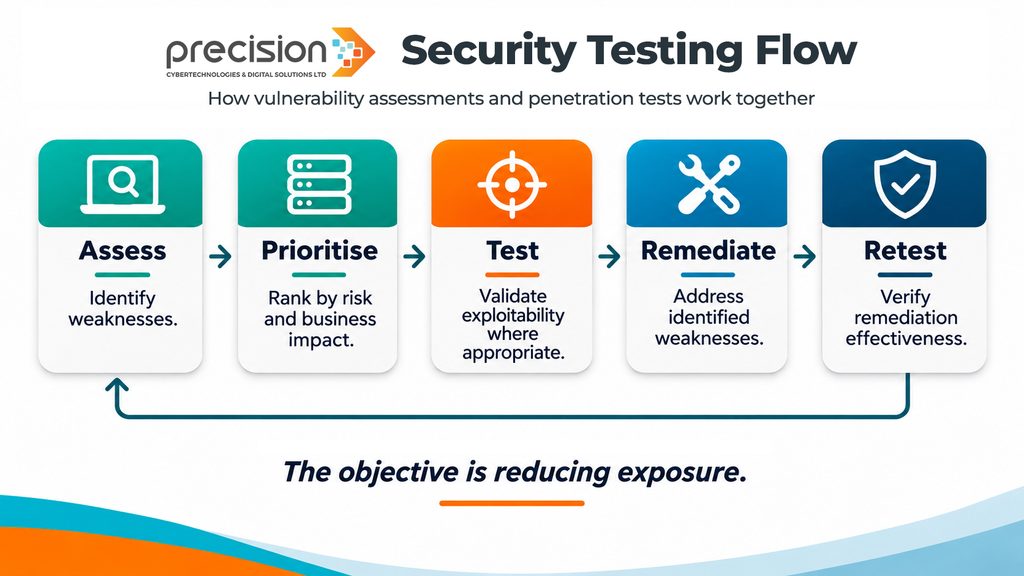
Assess → Prioritise → Test → Remediate → Retest
A Vulnerability Assessment helps identify where weaknesses exist. Penetration Testing provides deeper validation of selected areas and helps demonstrate possible real-world impact.
The objective of either exercise should not simply be producing a report. The objective is reducing exposure.
Identifying and validating weaknesses also contributes to broader organisational resilience. Explore what cyber resilience looks like in practice and why preparation, response and recovery matter beyond prevention.
Why annual testing alone may no longer be enough
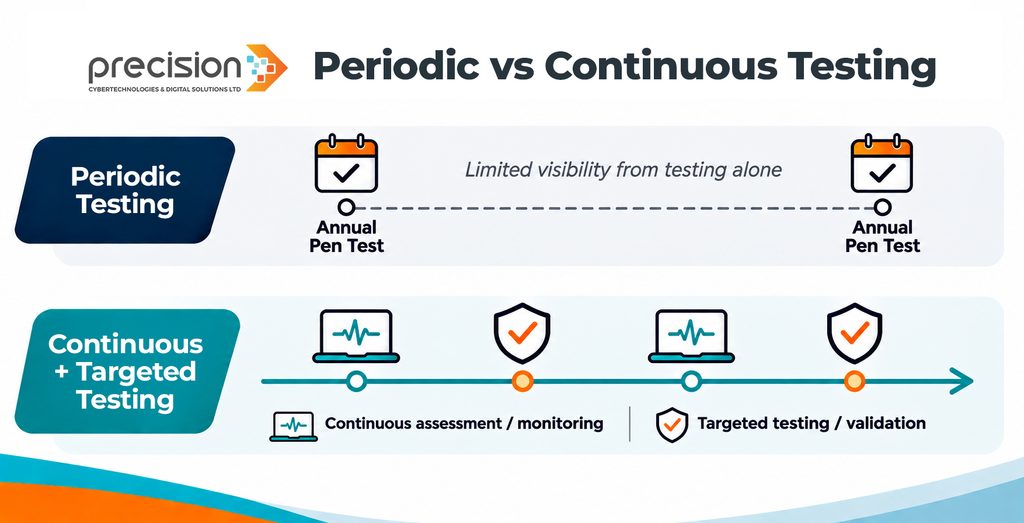
Modern technology environments can change significantly between testing periods. Organisations launch new applications. Cloud configurations change. Development teams add APIs. Employees and third parties receive new access. Security researchers continuously discover new vulnerabilities, and AI systems create additional connections, permissions and dependencies.
At the same time, attackers are moving faster. Microsoft’s 2026 Digital Defense Report says the median time from vulnerability discovery in the wild to weaponisation has fallen to well below 24 hours, while remediation for critical externally exposed vulnerabilities can still take 30 to 60 days.
Gartner’s 2026 research argues that traditional penetration testing cannot always keep pace with the speed and complexity of modern environments and points toward a more continuous testing discipline.
That does not make traditional Penetration Testing irrelevant. It means organisations increasingly need to think beyond: “When was our last Penetration Test?” and ask: “How continuously do we understand and validate our exposure?”
What should you ask a cybersecurity provider?
- What systems and applications are included?
- What is excluded?
- Is testing automated, manual or both?
- Will vulnerabilities actually be exploited?
- How will the provider prioritise findings?
- Will the provider provide remediation guidance?
- Can the provider retest the fixes?
- How will sensitive information be protected?
Clear answers help ensure the exercise produces information the organisation can actually use.
Which one does your organisation need?
If your objective is broad visibility into weaknesses across your environment, start with a Vulnerability Assessment.
If you need to understand whether specific weaknesses can actually be exploited and what an attacker might achieve, a Penetration Test provides deeper validation.
For many organisations, the strongest approach is not permanently choosing one over the other. It is using both appropriately as part of an ongoing cybersecurity programme.
The right approach will differ between organisations. A regional enterprise operating across several markets may have very different testing requirements from a smaller organisation with a single environment, even if both face similar underlying cyber threats.
Not sure which assessment is appropriate for your environment?
PCDS helps organisations across Trinidad & Tobago and the wider Caribbean evaluate their exposure and determine an appropriate testing approach based on their systems, risk profile and business requirements.